Foundation prospecting with Cause IQ and Claude

Introduction
Lots of organizations are trying to figure out where AI tools fit into their workflows, and fundraising teams are no exception. Development staff and grant writers want to know: can an LLM like Claude, ChatGPT, or Gemini replace a dedicated grant research database like Cause IQ, Candid, or Instrumentl?
It’s a fair question. After all, LLMs are fast, easy to use, and often low-cost or free. At the same time, prospect research depends on knowing how recently a foundation gave, how much, to whom, and whether those patterns align with your organization's work. A list of funder names is only useful if it is based on actual grantmaking, not just likely or loosely related results.
For this case study, we narrowed the comparison to one specific task: building a list of private foundation prospects for a hypothetical Washington D.C. food bank. We focused on private foundations because their giving is often hard to see. Many do not publish grant guidelines or accept unsolicited proposals, which can make them an underused source of support. Looking at what they have already funded is a practical starting point for prospect research.
We used Cause IQ and Claude Opus 4.8 to see what each tool could do on its own, where each one fell short, and how they could work when used together. This isn't meant to be an exhaustive or scientific review of every AI tool. It's one practical exercise, as of July 2026, in building and evaluating a foundation prospect list.
Setting up the case study
This case study focused on working through a common prospect research task: building a list of foundation prospects for a specific type of organization in a specific geographic area. We chose a food bank in Washington D.C. as the example, since food banks are a common nonprofit type that is well-represented in foundation grantmaking data. This gave us a realistic scenario for testing how Cause IQ and Claude handle the same workflow.
Prospect research is the process of identifying and evaluating potential funders before investing time in outreach and applications. For this exercise, we wanted to understand whether each tool could provide enough information to evaluate funder fit, not just return a list of names.
The goal was not just to create a list of foundation names. We wanted enough information to understand whether past grantmaking aligned with the work of a D.C. food bank.
We followed the same workflow in Cause IQ and Claude: searching for relevant foundation prospects, researching one identified funder in depth, looking at a peer nonprofit's funding sources, and then using the results to create a plan of action. Cause IQ tasks were completed with a Core subscription and Claude tasks were completed with an Anthropic Pro subscription using the Opus 4.8 (High) model.
Building the initial prospect list with Claude
Prospect research often begins by looking for foundations with a history of funding similar organizations. For the first step in this case study, we searched for private foundations that made recent grants to food banks in the Washington D.C. area.
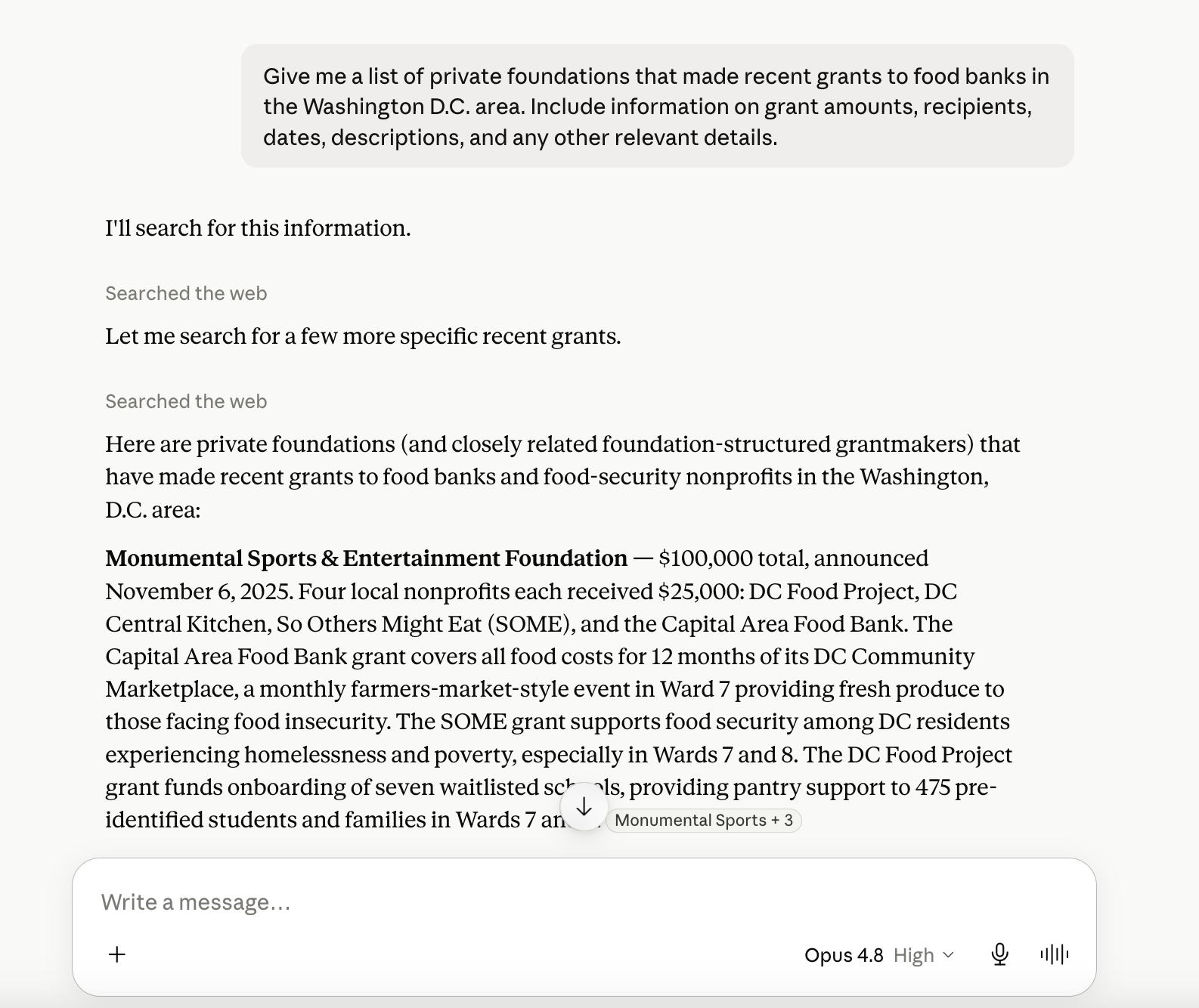
We used the following prompt in Claude:
Give me a list of private foundations that made recent grants to food banks in the Washington D.C. area. Include information on grant amounts, recipients, dates, descriptions, and any other relevant details.
Claude returned a narrative response including five foundation prospects, along with an explanation of why each one might be relevant. Each funder was written up as its own paragraph, with grant details for several recipient nonprofits grouped together. This made it harder to pick out specific grant dates, amounts, and descriptions at a glance. Claude also flagged at the end of its response that several funders were corporate or company-affiliated private foundations rather than independent ones, and suggested reviewing 990-PF filings directly.
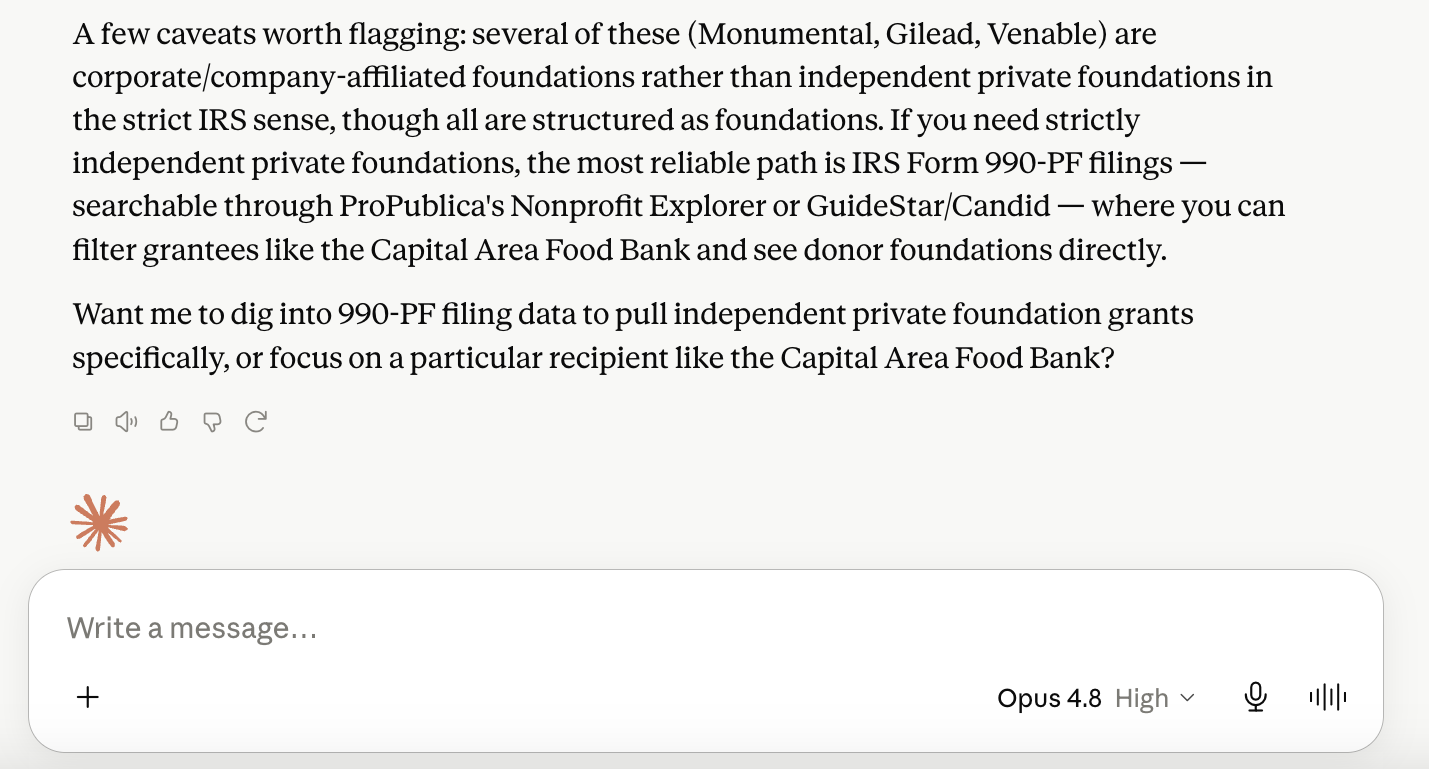
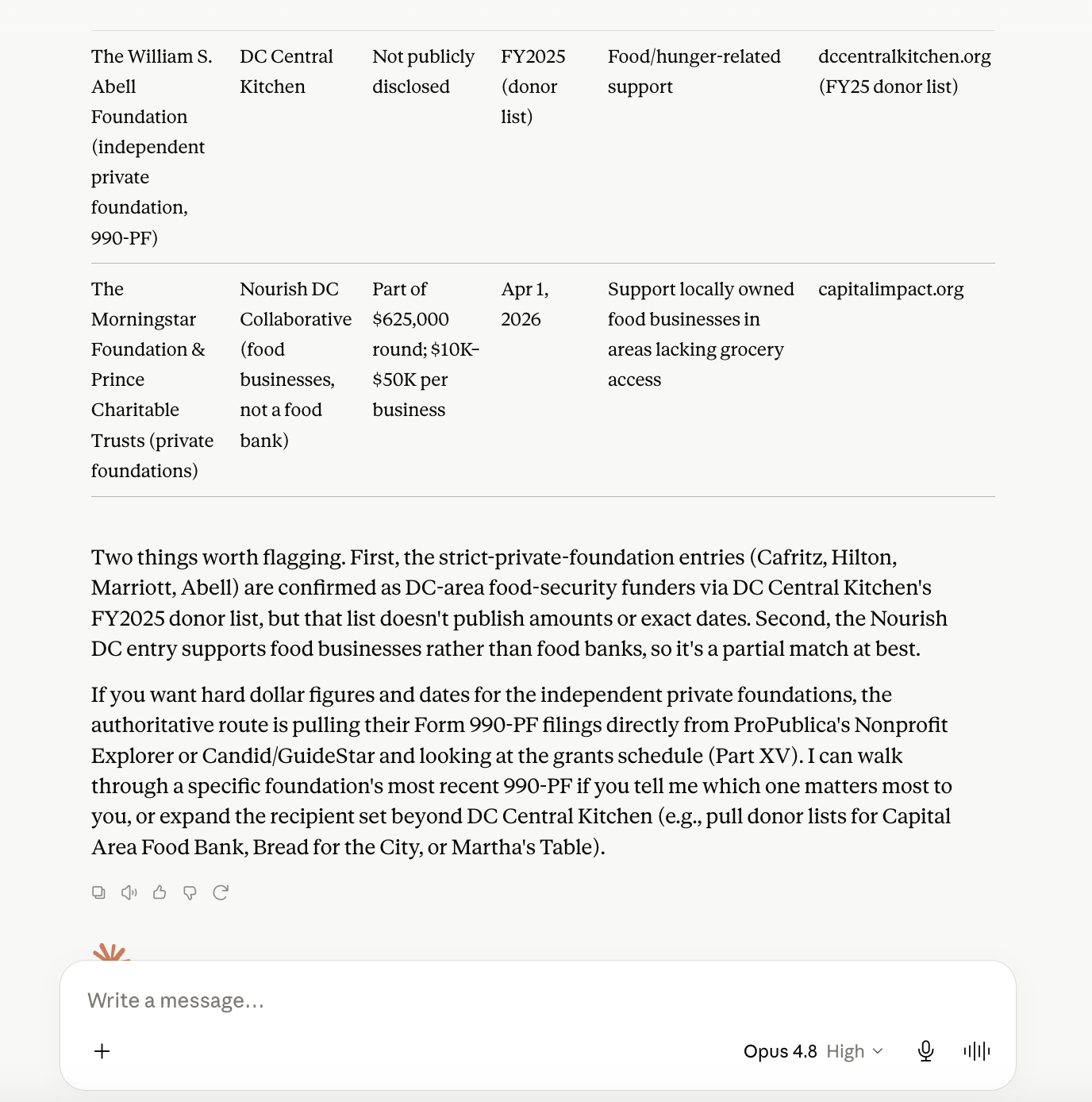
We followed up and asked Claude to focus on independent private foundations and organize the results in a table so the information would be easier to read.
The follow-up made the response more useful. Claude organized results into a table of eight foundations and 13 corresponding grants, which made it easier to compare funders. It labeled each entry's foundation type, so we could see which were independent, and noted one result as a partial match because it supported food businesses as opposed to food banks. Some results also drew on a recipient organization's own donor list rather than a Form 990-PF filing, showing that Claude could find funders whose giving may not yet appear in a tax filing. Those donor-list sources often left out grant amounts or dates, but for the initial identification step, they could still give a development team useful leads to investigate further.
Building the initial prospect list with Cause IQ
In Cause IQ, we opened the foundation search tool and added filters corresponding to this search:
- Foundation types - “Private foundations”
- Grant recipient type - “Food banks”
- Grant recipient location - “Washington D.C.” (metro area)
- Most recent grants only - “Yes”
The search returned 729 foundations and 1,095 corresponding grants. Cause IQ provided two ways to view the results: a structured list of funders that could be sorted by name, assets, or number of grants made, and a corresponding Grants tab with individual grant details, including grant amounts, recipient names, fiscal years, and descriptions.
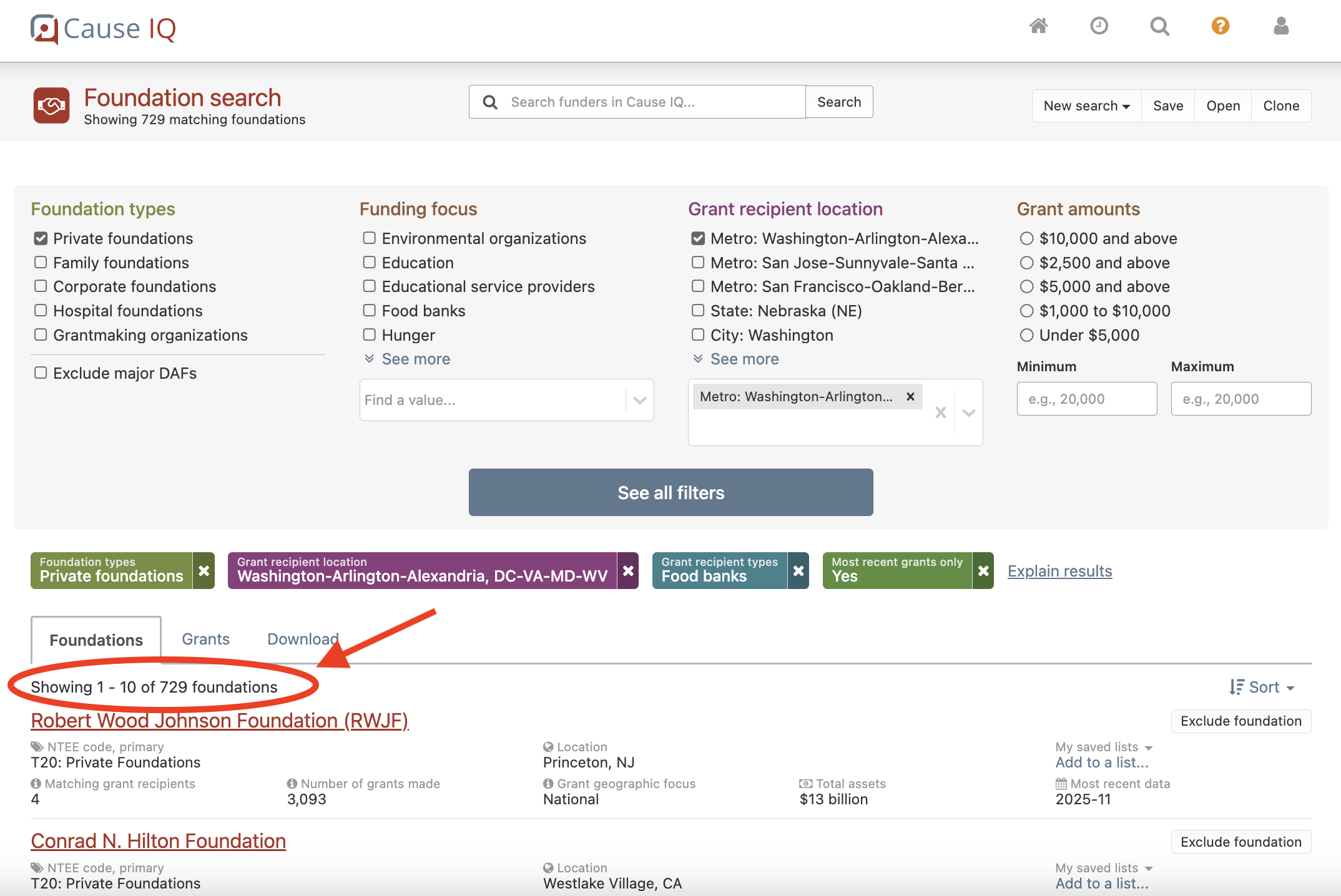
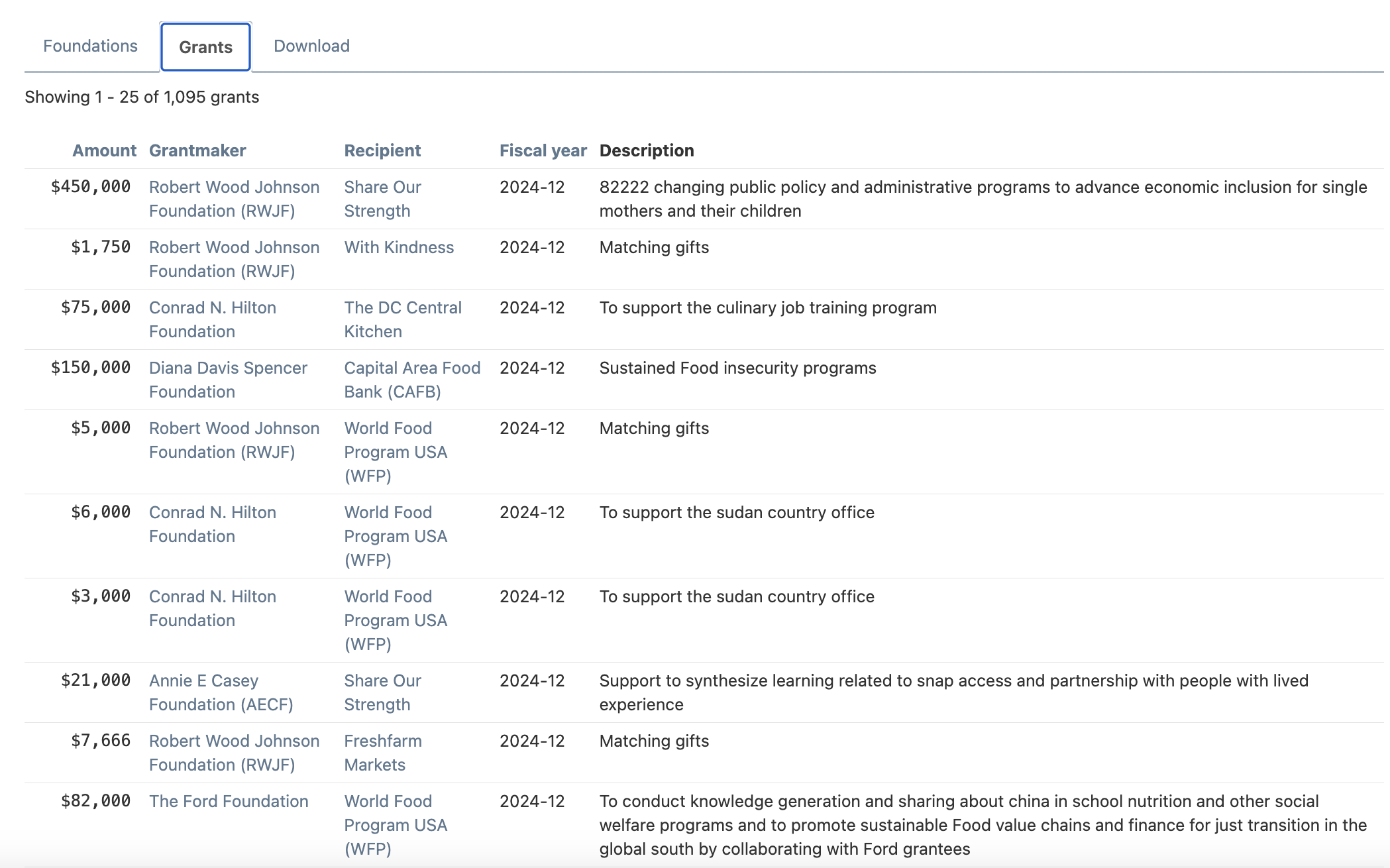
This was an entirely different kind of result and user experience. Cause IQ did not explain the results the way Claude did or call out any limitations in the data. Instead, it returned structured lists of funders and grants that could be sorted, narrowed, and reviewed based on the research task at hand. That structure is useful for prospect research, but it requires more familiarity with the Cause IQ interface than typing a prompt into Claude.
The two tools approached the search from different directions. Cause IQ began with a broad set of grant-based results, while Claude started with a smaller set of recommendations that we could refine through follow-up prompts. Neither approach is inherently better. For this search, starting broad in Cause IQ gave us a wider view of the potential funder landscape before deciding where to drill down further.
Researching one foundation in depth with Claude
Once a funder appears on a prospect list, the next step is determining whether its recent grantmaking is a good fit for the organization. For this part of the case study, we selected Morris and Gwendolyn Cafritz Foundation, which appeared in both Cause IQ's and Claude's results and is a well-known D.C. funder.
In Claude, we asked:
What grants did Morris and Gwendolyn Cafritz Foundation make to food banks in the Washington D.C. area in its most recent year of grantmaking? Include grant amounts, dates, recipients, purposes, and sources in a table format.
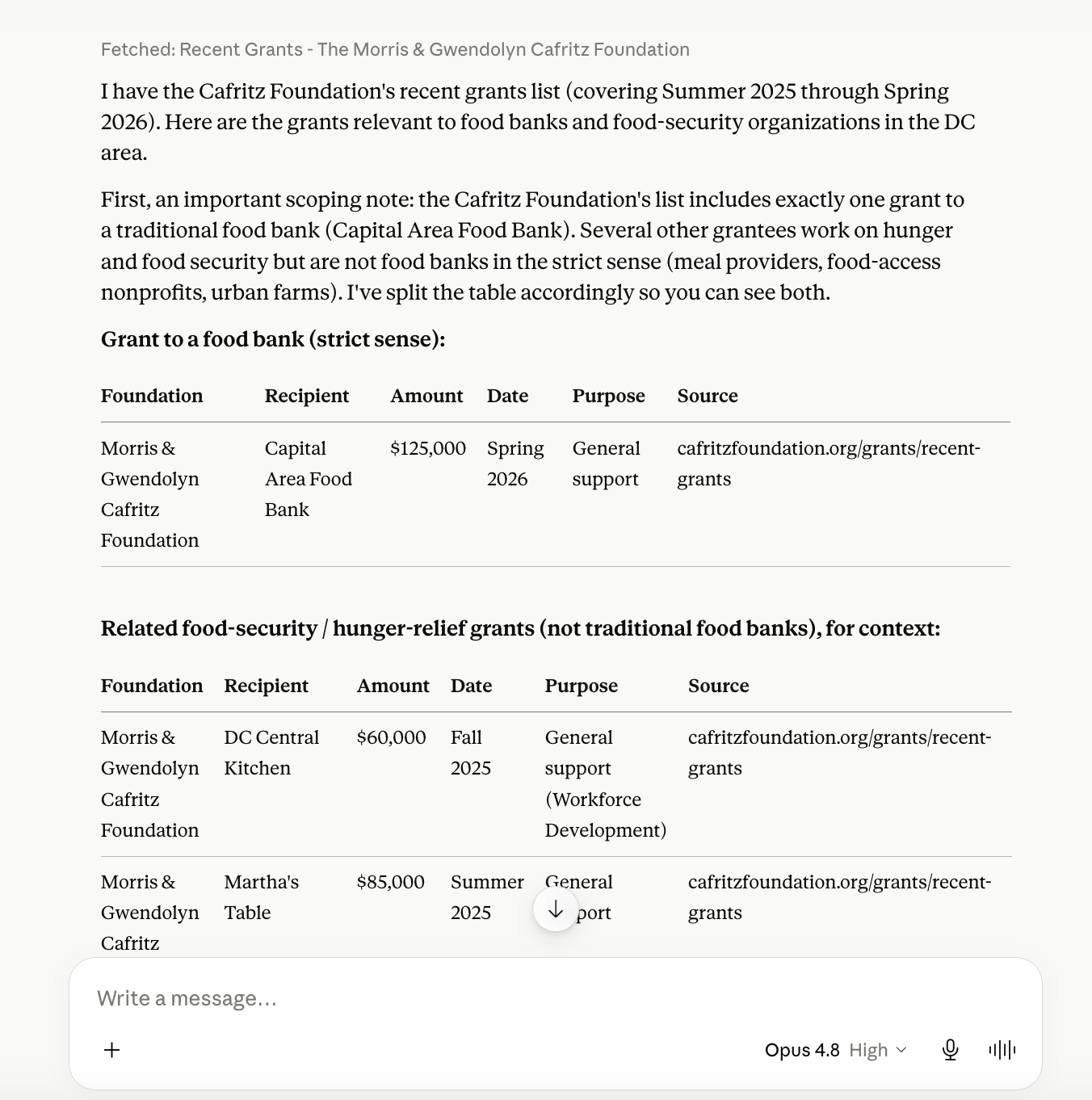
Claude found Cafritz Foundation's recent grants from the funder's own website and returned a table covering Summer 2025 through Spring 2026. Claude identified one clear grant to a traditional food bank: a $125,000 Spring 2026 general support grant to Capital Area Food Bank. It also listed seven related food-security or hunger-relief grants to organizations like The DC Central Kitchen, Martha's Table, and Food & Friends.
This response was useful because Claude separated the standalone food bank grant from the food-related grants, and noted that the foundation's website uses seasonal dates instead of exact grant dates.
Researching one foundation in depth with Cause IQ
In Cause IQ, we opened Cafritz Foundation's profile page and navigated to the Grantmaking tab. From there, we filtered the list of grants made by grantee type and location, selecting food banks in the Washington D.C. metro area. Cause IQ identified seven grants made to seven nonprofits for the foundation's most recently filed tax year, FYE April 2025. A table displayed grant recipient names, EINs, grant descriptions, and grant amounts. Each grant also included a Details link where we could see the funder's grant history with each recipient going back several years.
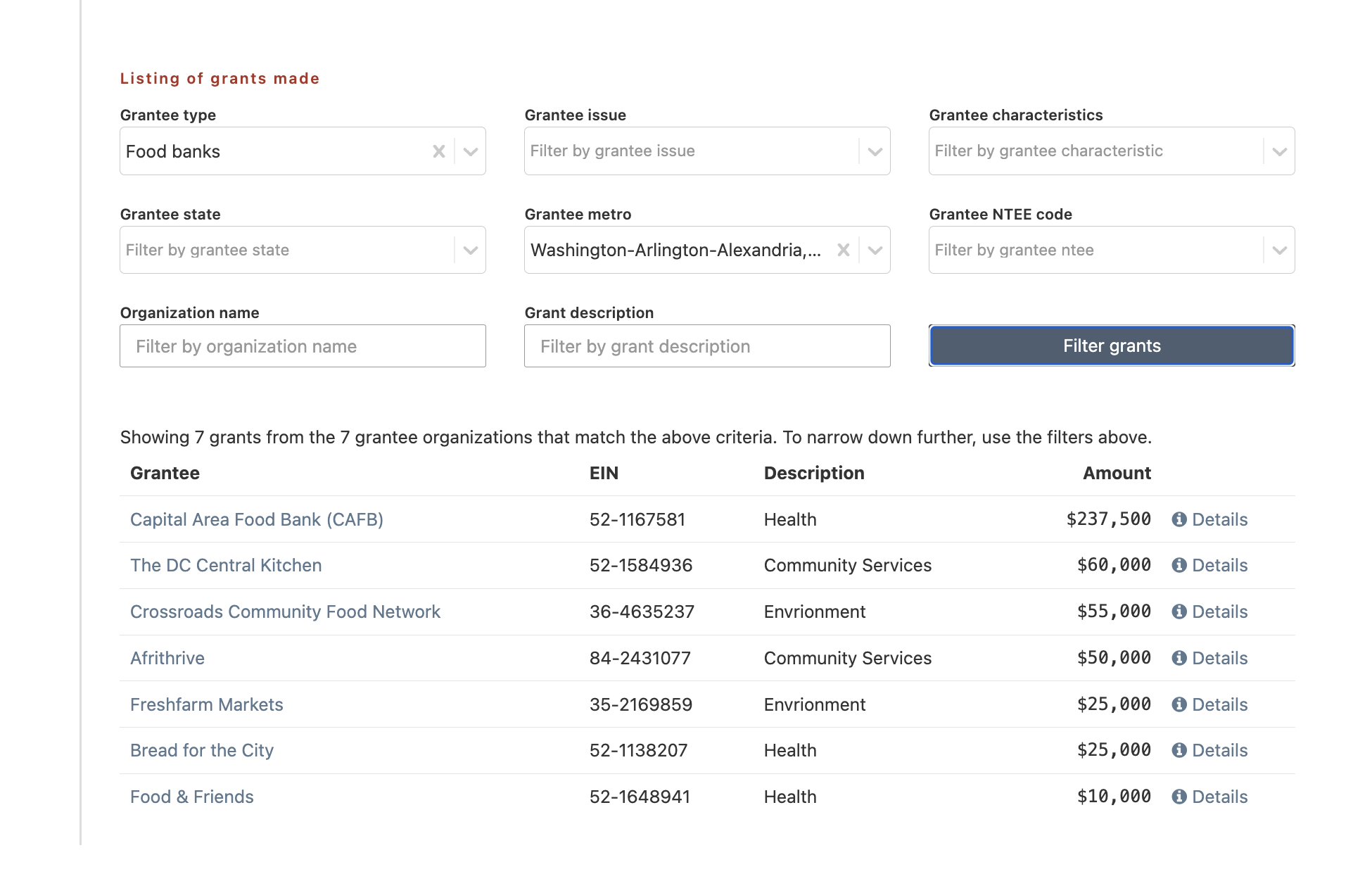
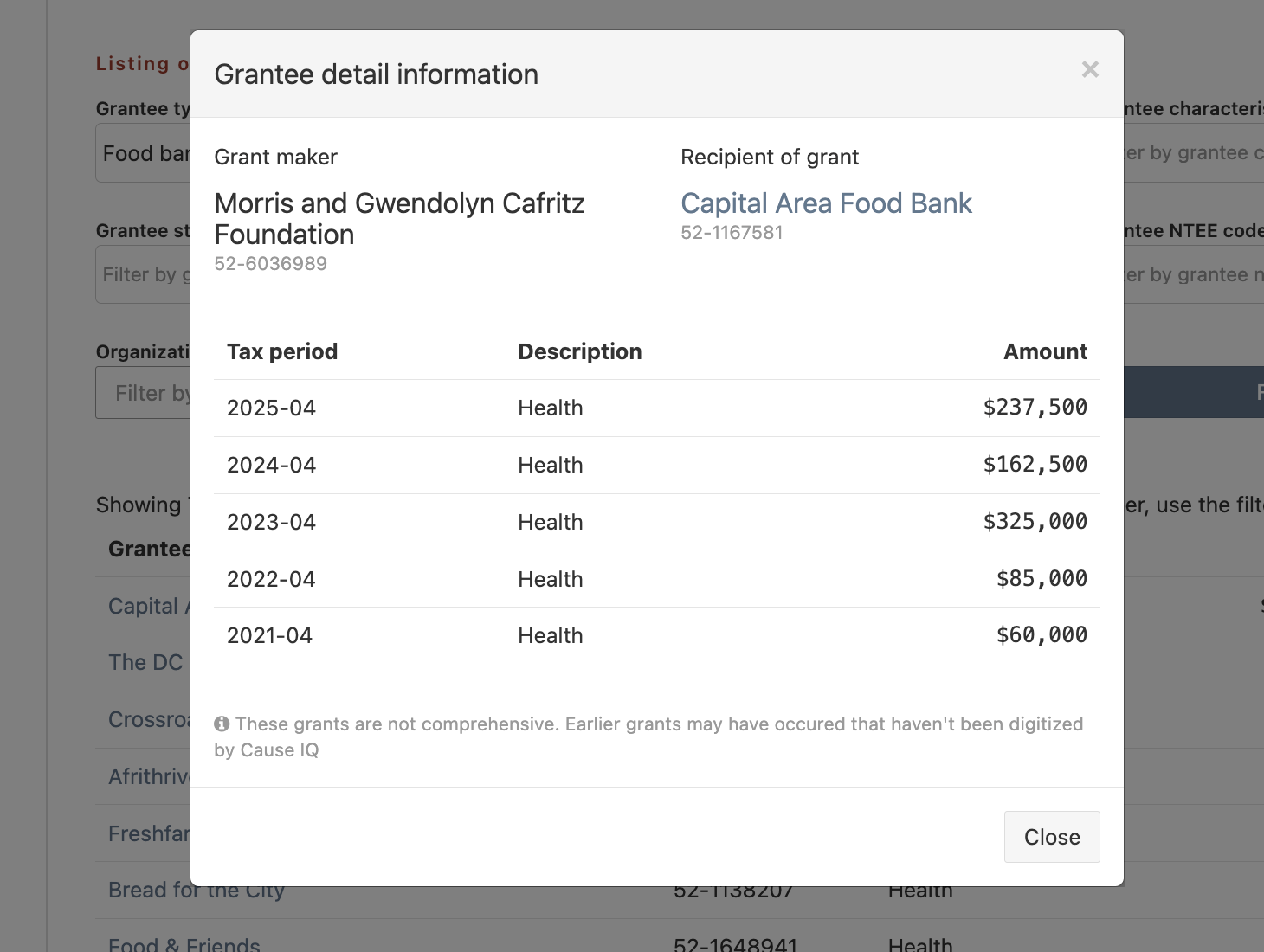
For a foundation like Cafritz, using both tools gave a fuller picture. Claude caught one very recent grant the foundation posted on its own website, while Cause IQ provided Cafritz's reported grant history from Form 990-PFs, including its longer history with grantees. Cafritz is not a typical case, though; most private foundations do not publish recent grants on their websites, so for many funders Claude would not have the same visibility into recent grant activity.
Seeing where a peer nonprofit gets its grants from with Claude
Seeing where peer nonprofits get their grants from can be an effective strategy for identifying prospects that might not otherwise be found. For this part of the case study, we used Capital Area Food Bank as the peer organization and looked at how Claude and Cause IQ performed in finding which foundations have given them grants.
Claude prompt:
Give me a complete list of foundation grants Capital Area Food Bank recently received.
Claude was upfront about its limitations in this step, noting right away that Capital Area Food Bank does not publish an itemized list of grants received. Claude then provided a partial list pulling information from the organization's own annual report and website announcements. The list had a few useful examples, including the Spring 2026 Cafritz Foundation grant, but it was not enough to fully understand which funders support this nonprofit.
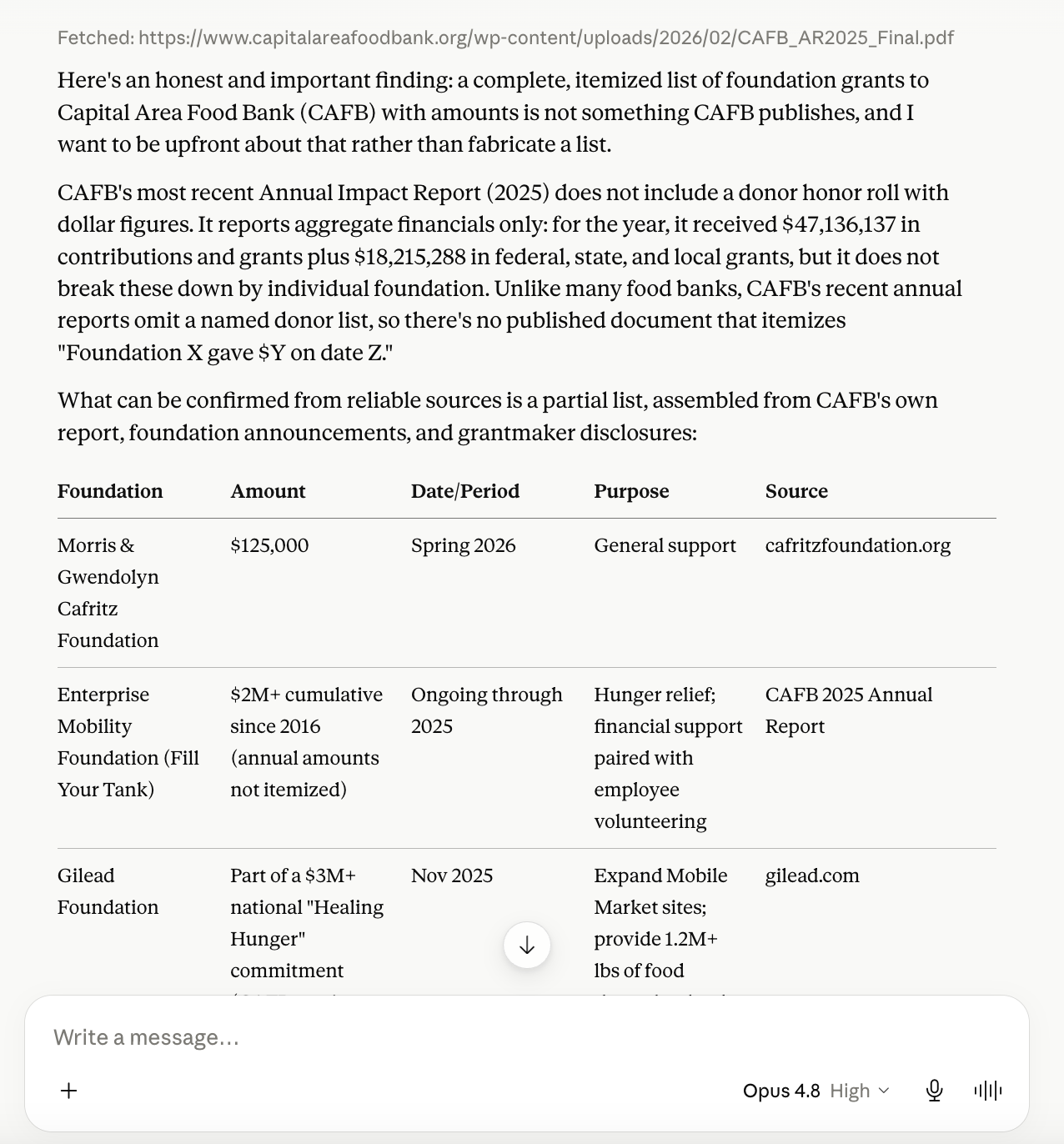
Claude also explained why this task is difficult to do from public sources alone. Peer grant data lives in the funders' Form 990s, where each foundation reports the grants it made and to whom. To build a more complete picture, a tool has to be able to search many foundation filings and connect those grants back to the recipient organization.
Seeing where a peer nonprofit gets its grants from with Cause IQ
In Cause IQ, we opened Capital Area Food Bank's profile and navigated to the Funding tab. Here we found a breakdown of the organization's funding sources, including a list of grants received from foundations and other nonprofits. Cause IQ found 254 grants totaling $26.9 million, with grantmaker names, tax periods, descriptions, and amounts listed in a table. This grant information came from the grantmakers' tax filings, meaning the data was pulled from the funder side and connected back to Capital Area Food Bank as the recipient.
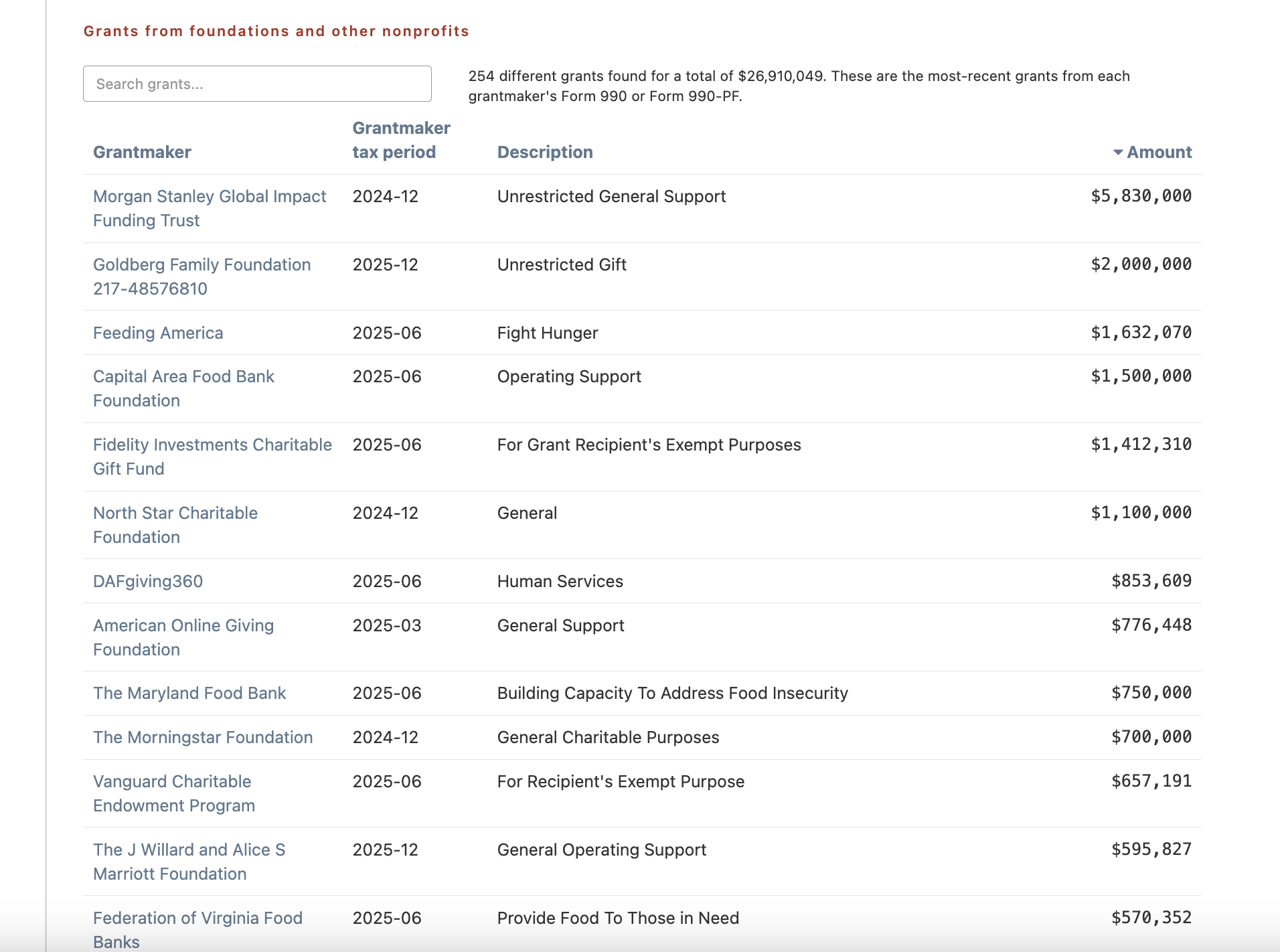
Cause IQ gave us a detailed peer funding view that Claude could not produce from public web sources alone, while Claude provided useful individual examples and explained why this information is difficult to find online.
By this point a pattern had emerged. Claude was good at explaining and contextualizing results, while Cause IQ built detailed, grant-backed lists from Form 990 data. That pointed to a natural next step: using them together.
Using Cause IQ data with Claude
After using Cause IQ to build a list of foundation prospects, we turned to Claude to help interpret the results and brainstorm next steps.
To do so, we first downloaded the list of Cause IQ foundation search results used earlier in the case study. The file included the list of 729 private foundations that made grants to D.C. food banks in their most recently reported year of grantmaking, along with details for 1,095 grants including grant amounts, recipient organization names, fiscal years when each grant was made, and descriptions.
We then uploaded the file to Claude with a prompt written from the perspective of a new food bank:
I'm a new food bank in the Washington D.C. metro area. Based on the attached list of grants that private foundations made to D.C. food banks, which foundations should I reach out to that could help fund my nonprofit?
This is where Claude became especially useful as an analysis tool. Using the Cause IQ file as its starting point, Claude recognized that the best prospects for a new food bank were not necessarily the largest funders. It prioritized foundations that had given to several different D.C. food organizations, made recent grants, and showed repeated giving patterns.
Claude grouped the funders into categories, including local food-security funders, mid-size prospects with moderate grant amounts, higher-capacity prospects to cultivate over time, and corporate or matching funders that could help build early funding momentum. It also gave useful context for outreach, such as matching ask amounts to a funder's typical gift size and looking for warm introductions to family foundations or funders that already support peer nonprofits.
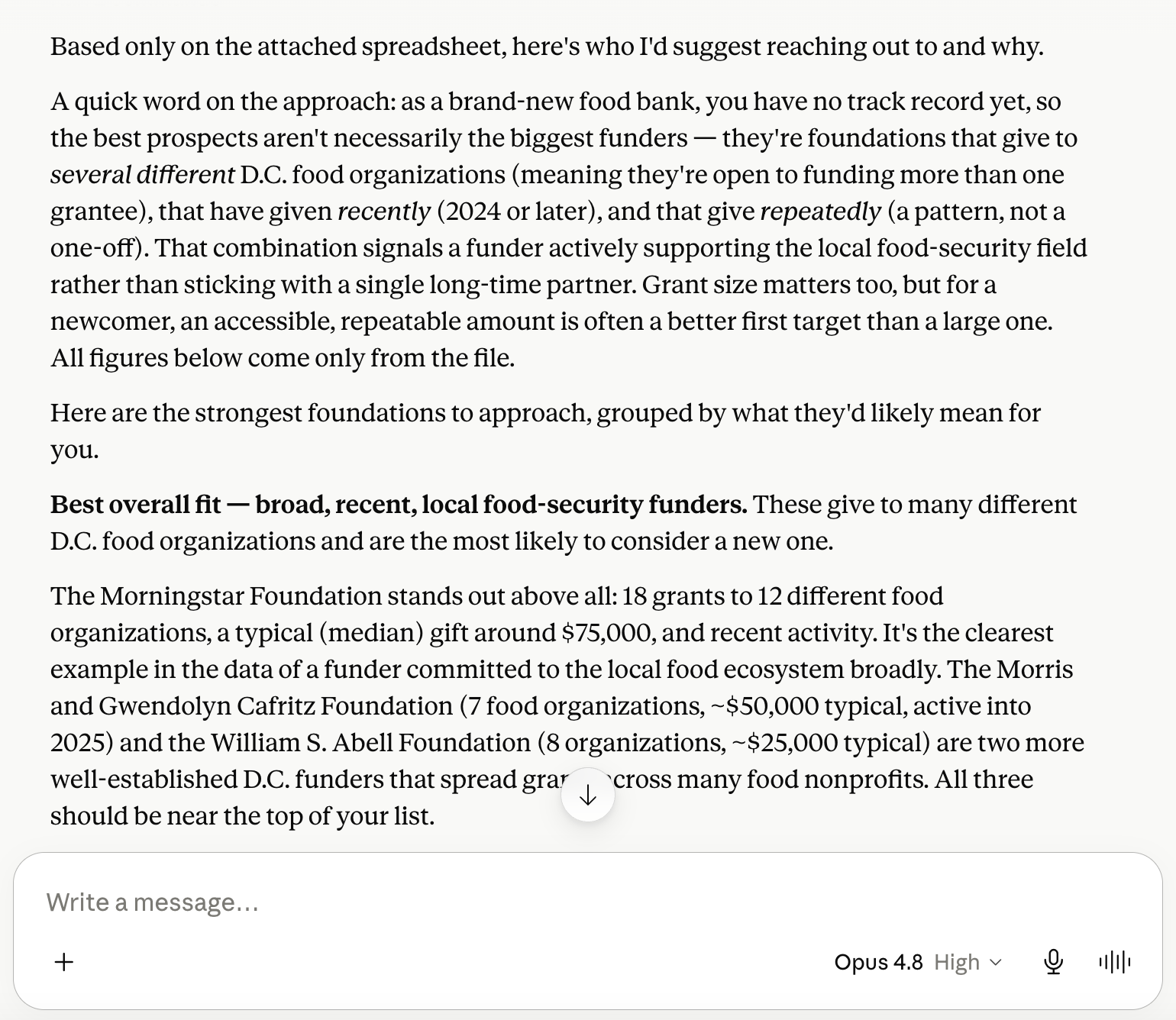
This example showed how the two tools could work together. Cause IQ supplied the underlying grant data, while Claude helped turn that information into a more usable prospecting plan. The result was not just a list of funder names, but an explanation of which prospects looked most approachable for a new food bank, why they stood out, and how to think about next steps.
What the case study showed
Throughout the case study, Claude was most useful when explaining and interpreting information. It could summarize what it found, flag limitations, and turn a large spreadsheet of grant data into outreach recommendations. It was less suited to building the underlying grant list on its own from online sources.
Cause IQ handles a different part of the workflow: building the initial search results, connecting grant data from funder Form 990s to recipient organizations, and showing funder-recipient grant relationships over time. Cause IQ takes more familiarity to use than typing a prompt into Claude, and very recent grants will not appear until a funder has reported them on its Form 990.
The clearest workflow was using Cause IQ first to build a prospect list based on reported grantmaking, then using Claude to interpret the data in the context of a specific fundraising need. Once Claude had structured data to work from, it could identify patterns, group funders by fit, and suggest how a development team might approach outreach.